Apple’s IOS Major Security Flaw

It has just been revealed on Monday that Apple has a significant security bug in their FaceTime app.

Contributor
Photo Credits: Getty Images

Looking at the article, Attorney Michele Thompson posted about her son’s discovery of this bug, which allowed a FaceTime caller to eavesdrop on the recipient without them knowing that the caller can listen to what is happening on their end, all without answering the call. The attorney states that she has been posting about this issue since January 20 and it took Apple a little over a week to address the matter.

Video Demonstrating The Bug

The video above by MacRumors shows how the glitch can be reproduced and analyzed. It appears that the glitch does in fact allow both parties to hear each other without the recipient’s call acceptance. Then if the recipient presses the lock button after the call is initiated, the caller can see what the front-facing camera is picking up–all without a notification, leaving the recipient never even knowing that they can be seen.

Axios has received a statement from Apple stating that:


“We’re aware of this issue and we have identified a fix that will be released in a software update later this week” 

Apple to Axios

While they are fixing the issue, Apple has temporarily shut off FaceTime services for group calls:
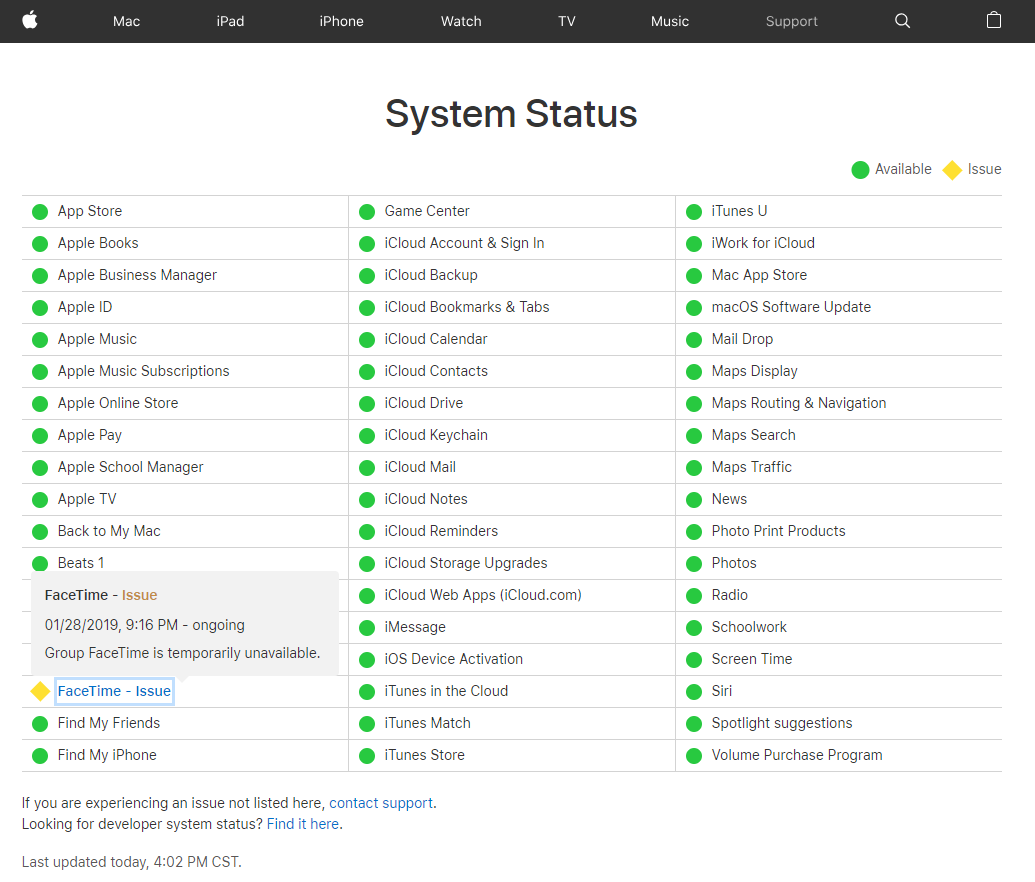
Screen capture taken off the system status page

Apple has always been a company that takes the privacy and security of their users very seriously. So, I do believe that they will be working hard to prevent issues like this to come up again. Since the Group FaceTime feature is a new feature, for it to be foolproof on launch is rarely the case. Issues that weren’t discovered when the quality control team was testing the stability will emerge eventually, once millions of every day users start to push the limits of the app. Hence, this case should not discourage users from feeling that Apple is now beginning to slip on privacy and security.

Facebook Messenger Unites with WhatsApp and Instagram

Just this Friday, Facebook founder and CEO Mark Zukerberg has announced that he is making plans to allow users from all of these social-networking services to message each other across the different platforms.

Logos of WhatsApp, Facebook Messenger, and Instagram. Photo Credits: BBC.

The plan has been initiated and is currently in its early stages but the target for when all the services are to be linked up is by early 2020. Now this means that these independently-run companies, which are also owned by Facebook, are now being pushed to become a part of the Facebook ecosystem.

The Good News

This plan can leave some good news for all of these users. Now those who refuse to make an account on the other services (possibly they don’t like the features of the other apps) can message those on the other services, without having to make another account. This can also mean that those who have opened an account for the sole reason to message those who don’t have an account on their preferred service can close or deactivate that account now. Who doesn’t like not having to remember another password?

Photo Credits: Hacker Noon

The Bad News

Facebook has had many incidents in recent years where they have been exposed for selling and tracking private user information. And now Facebook is dipping its fingers into the companies who they had let run fine independently. This can probably lead to (hopefully not) another privacy scandal where Instagram and WhatsApp have their user information sold since Facebook is going to start managing the user to user messaging across all platforms.

Photo Credits: Make Use Of

While Facebook’s integrity is not fully gained back, I feel like this may be a good move for all users. If Facebook learns from its previous mistakes and learns to keep its user’s privacy secured, it will succeed with this transition and its trustworthiness can be reestablished. Even then, lots of apps have had aspirations of being able to interact with each other and since Facebook is making plans for this, it may lead to others following suit.

Another Foldable Smartphone?

A small mobile tech company, Royole, has announced late last year their upcoming flagship, the Royole FlexPai, which demos a fascinating feature where it can be folded in half.

FlexPai showing off its unique feature. Photo Credits: Royole

Phone Features:

This particular flagship developer phone has phenomenal specifications and carries just enough power under the hood after taking a look at the official product specifications online:

  • Qualcomm Snapdragon 855, an OctaCore processor rated at a 2.84GHz clock speed
  • A 7.8 inch Flexible AMOLED screen paired with a beautiful 1920 x 1440 QHD resolution display.
  • 6GB RAM base, 8GB RAM max
  • 128GB storage base, 256GB storage max (SD cards are accepted for up to 256GB of additional storage)
  • 2 digital cameras: 16MP + 20MP
  • A 3970 mAh battery

To describe these mobile phone specs that the FlexPai offers, is to say that they are very competitive with other well-known smartphone manufacturers. But it all comes at a cost for this one-of-a kind feature:

It starts at $1300 or $1500 for the top model

The specifications do look tempting but the price tag will hold many potential buyers back. Now, I wouldn’t ever justify spending that amount of money for a phone that is still under testing, unless you are a developer and really want to experiment with it. And since it is a developer product, The Verge has reported during the phone’s demonstration that


The software seemed extremely sluggish, apps continuously opened accidentally, and the orientation kept changing randomly when one of the Royole representatives was demonstrating the folding process.

Nick Statt, The Verge

After hearing this I would suggest to all of you who would consider a phone like this to wait on it. New technologies and trends like this will take time to polish. So it would be indefinitely safer to wait and buy a stable phone as opposed to one like this. This phone will simply only get frustrating to have the phone do what it should, and trust me, I’ve unfortunately had my fair share of dealing with phones like that, and it is not a road I recommend taking.

Photo Credits: Royole

Tesla’s Sudden Job Cuts

It’s major news that Elon Musk, the founder and CEO of both Tesla and SpaceX, has just announced on Friday a layoff of 3,000 people of his 45,000 people combined workforce. This 7 percent job cut is planned to be used to make his Tesla Model 3 prices more affordable, which currently start at $45,000 MSRP, to a price decreased to $35,000 MSRP.

Tesla Model 3 in Deep Blue Metallic. Photo Credits: Digital Trends.

Elon Musk has also announced earlier this month the order of constructing a $2 billion Tesla gigafactory in China, which is the first ever car plant owned by a foreign country. This should result in cheaper labor for automobile manufacturer as the factory is built and run in China.

Render of the first Tesla Gigafactory in Nevada. Photo Credits: Tesla

Now after hearing all this, I feel like it does not look too good for Musk’s credibility. In the start of 2019, Elon Musk announced a $2 billion factory in China and now he decides to layoff American employees in order to save money by outsourcing labor to foreign countries.

This plan may be beneficial for Tesla to grow in the long-term, but many investors feel uncertain about future of the company since the layoff as Tesla shares have dropped 13 points down by $45 to $302.26 per share after Friday’s announcement.